


Why lens choice matters

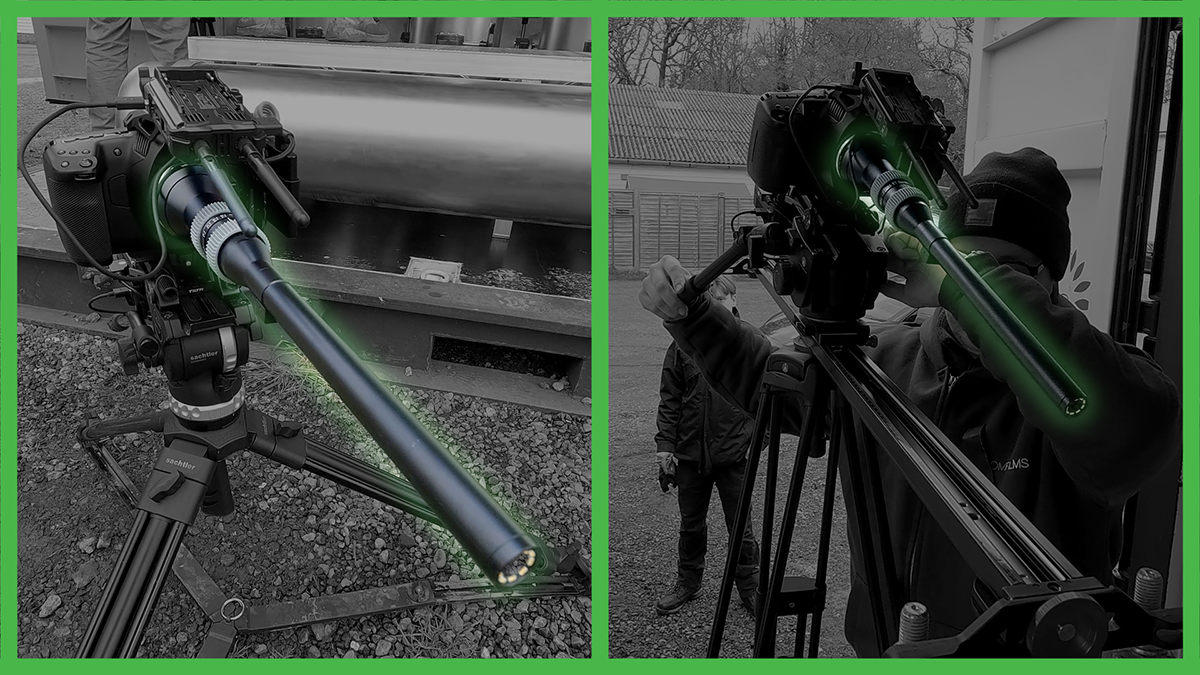
Letting the lens tell the story
Reader discretion advised: this is one for the tech geeks!
On a recent film project we made a very deliberate decision to use the Laowa 24mm f/14 2x Macro Probe lens and it deserves a proper moment of appreciation.
The Laowa probe is a long, tubular macro lens designed to capture extreme close-ups while maintaining a wide-angle field ofview. That combination is unusual. Traditional macro lenses tend to compress the scene and isolate the subject, but the probe lens allows the camera to travel through spaces and environments while still revealing microscopic detail.
It’s a lens that quite literally lets the camera go where other lenses can’t. Now, this isn’t a piece of kit you’d deploy on every shoot. Like most specialist lenses, it’s very much ‘horses for courses’. But for this particular project it was exactly the right tool.
The client’s product involved intricate engineering and precision manufacturing. Rather than simply film the finished item, we wanted the viewer to experience the craftsmanship and high-performing elements embedded within it. The probe lens allowed us to move the camera through the product’s internal structures, capturing incredibly detailed macro shots while still retaining context and scale.
The result was a visual intimacy that brings the viewer right into the engineering itself.
Lens Language: The subtle layer of storytelling
What’s interesting about lens choice in video production is that it often communicates meaning long before the viewer consciously realises it.
Different lenses change how audiences interpret what they’re seeing. Wide lenses exaggerate spatial relationships and immerse viewers in environments. Longer lenses compress distance and isolate subjects. Macro lenses reveal details that the human eye might otherwise miss. Together, these choices form what videographers and cinematographers often refer to as “lens language.”
In this case, the Laowa probe helped communicate a series of implicit messages without needing a single line of narration.
Extreme close-ups of moving components instantly signal ideas like ‘precision engineering’, ‘high-performance detail’, ‘exact measurement’ and ‘quality manufacturing’.
The audience may not consciously think “that’s a macro probe lens shot”, but they instinctively read the visual cues. Get the optics right and the story begins to tell itself.
Two other lenses that shape storytelling
The probe lens is just one example of how specific optics can influence the narrative tone of a project.
The Canon RF 10–20mm f/4L IS STM, for example, has become a favourite for immersive environment work. Its ultra-wide field of view exaggerates spatial depth and makes viewers feel physically present in the scene. It’s particularly effective for architecture, manufacturing environments or large-scale infrastructure projects where the goal is to emphasise scale and context.
On the other end of the spectrum, the Sony FE 135mm f/1.8 GM is widely used across UK productions for its ability to isolate subjects with beautifully compressed backgrounds and extremely shallow depth of field. It’s a lens that excels in interviews, product hero shots and emotional storytelling because it pulls attention precisely where the filmmaker wants it.
Both lenses technically “record an image,” but the psychological effect on the viewer is completely different.
Technology in service of story
As camera technology continues to evolve, there’s often a temptation to focus on the body: resolution, codecs, sensors and frame rates. But in many cases, the lens choice is doing the real storytelling work. Guiding attention, creating emotional tone and reinforcing brand messages without a single word being spoken.
Which is why, sometimes, choosing a lens isn’t just a technical decision, it’s a narrative one, and when you get the lens language right, the story almost tells itself.
Related Articles





zoomfilms
AGENCY

